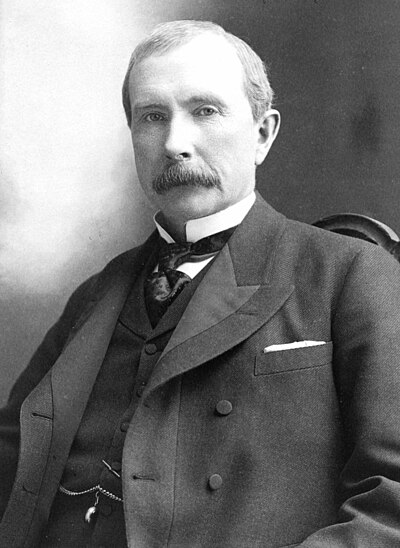
John D. Rockefeller
Founder of Standard Oil, who dominated the American petroleum industry.
Who was John D. Rockefeller?
John D. Rockefeller was an American industrialist who founded the Standard Oil Company, establishing near-monopoly control over the petroleum industry. His strategies optimized efficiency and dramatically reduced the cost of oil products.
Data & analysis
- Founded Standard Oil in 1870, quickly consolidating the American oil refining industry.
- Controlled approximately 90% of US oil refining capacity by the early 1880s through aggressive horizontal and vertical integration.
- Established the Standard Oil Trust in 1882, a corporate structure that influenced industrial organization and economic concentration.
John D. Rockefeller (1839-1937) fundamentally reshaped the American petroleum industry during the industrial revolution through his founding of Standard Oil in 1870. By the early 1880s, his aggressive horizontal and vertical integration allowed his company to control approximately 90% of US oil refining capacity, a measurable dominance that slashed the cost of petroleum products for consumers. The establishment of the Standard Oil Trust in 1882 created a corporate structure that maximized efficiency but also concentrated economic power to an unprecedented degree, inviting intense public scrutiny. This concentration ultimately led to the 1911 antitrust breakup, which profoundly influenced corporate law by establishing that monopolistic practices could be dismantled to preserve market competition. Critics note that Rockefeller’s methods, including predatory pricing and secret rebates, often crushed rivals through means that later legislation deemed illegal. The trust’s dissolution dispersed vast wealth into new energy ventures, setting a precedent for regulating industrial consolidation. Today, debates over monopolistic power in technology and energy sectors still echo the tensions between efficiency and competition that Rockefeller’s empire first made visible.
“Don't be afraid to give up the good to go for the great.”
— John D. Rockefeller, Attributed to Rockefeller.
John D. Rockefeller, born in 1839, was an American industrialist and philanthropist who founded the Standard Oil Company. Beginning in 1870, Rockefeller rapidly expanded his oil refining operations, employing aggressive business tactics such as horizontal integration—acquiring rival refineries—and vertical integration, controlling pipelines, barrel factories, and retail outlets.
Through these methods, Standard Oil achieved an extraordinary degree of market control. By the early 1880s, the company controlled approximately 90% of the oil refining capacity in the United States, effectively dictating prices and distribution. This concentration of power dramatically reduced competition but also drove immense efficiencies in production and transportation, making kerosene and other oil products widely affordable.
Rockefeller's organizational innovation included the creation of the Standard Oil Trust in 1882, a legal entity that allowed him to control multiple companies across state lines. This structure enabled coordinated pricing and production strategies across a vast industrial empire, maximizing profits. The trust model became a template for other large industrial combinations of the era, drawing scrutiny from antitrust reformers.
In 1911, the Supreme Court ruled that Standard Oil was an illegal monopoly and ordered its dissolution into 34 separate companies, including entities that would become ExxonMobil, Chevron, and BP. Despite the breakup, Rockefeller retained significant shares in these new companies, and his personal wealth continued to grow, making him one of the wealthiest individuals in history. He passed away in 1937, having also committed substantial funds to philanthropy.
Key Contributions
- Founded Standard Oil in 1870, quickly consolidating the American oil refining industry.
- Controlled approximately 90% of US oil refining capacity by the early 1880s through aggressive horizontal and vertical integration.
- Established the Standard Oil Trust in 1882, a corporate structure that influenced industrial organization and economic concentration.
- Driven by a Supreme Court ruling in 1911, the dissolution of Standard Oil created 34 independent companies, fundamentally reshaping the energy market.
Legacy
John D. Rockefeller's Standard Oil demonstrated the power of industrial consolidation and efficiency in controlling an entire market, significantly reducing the cost of petroleum products. His business model and subsequent antitrust breakup profoundly influenced corporate law and the structure of modern industry, dispersing vast wealth into new energy entities.