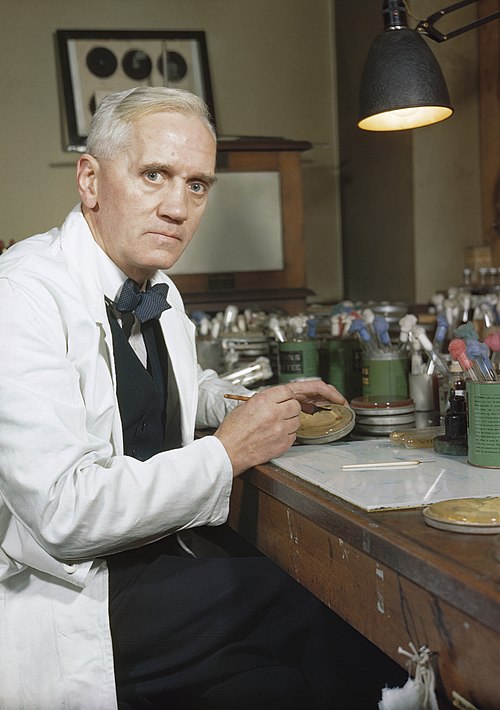
Alexander Fleming
Microbiologist whose discovery of penicillin transformed medicine and public health.
Who was Alexander Fleming?
Alexander Fleming (1881-1955) discovered penicillin in 1928, initiating the age of antibiotics. This discovery dramatically reduced mortality from bacterial infections, improving global health outcomes and workforce productivity.
“One sometimes finds what one is not looking for.”
— Alexander Fleming, Speech at the Nobel Banquet, 1945
Alexander Fleming (1881-1955), a Scottish microbiologist, made a serendipitous discovery in 1928 that fundamentally altered medical practice and public health. While working at St Mary's Hospital in London, he observed that a mold, *Penicillium notatum*, inhibited bacterial growth in his laboratory cultures. This isolation of penicillin marked the advent of antibiotics, which would go on to treat a vast array of bacterial infections that had previously been fatal.
Key Contributions
- Discovered penicillin in 1928, noting its antibacterial properties from *Penicillium notatum*.
- Published his findings on penicillin in 1929, though mass production did not occur until the early 1940s.
- Shared the Nobel Prize in Physiology or Medicine in 1945 with Howard Florey and Ernst Chain for the development and therapeutic use of penicillin.
- The widespread availability of penicillin by 1944 drastically reduced mortality rates from bacterial infections, boosting healthy life years and economic productivity globally.
Legacy
Fleming's discovery of penicillin initiated the antibiotic era, transforming healthcare and human capital. The resulting decline in infectious disease mortality increased global life expectancy by several years and fostered the growth of a multi-billion dollar pharmaceutical industry focused on anti-infectives.