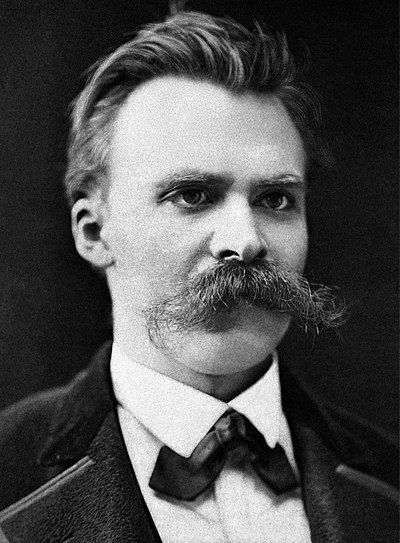
Friedrich Nietzsche
Critic of conventional morality, influencing cultural values impacting economic motives.
Who was Friedrich Nietzsche?
Friedrich Nietzsche (1844–1900) was a German philosopher who critiqued traditional morality, religion, and philosophy. While not an economist, his profound insights into human values and power dynamics indirectly influenced cultural shifts that shaped consumer behaviour, artistic production, and political ideologies with significant economic consequences.
“That which does not kill us makes us stronger.”
— Friedrich Nietzsche, Twilight of the Idols, 1889
Friedrich Nietzsche, born in Röcken, Prussia in 1844, was a classical philologist who transitioned to philosophy after health issues led to his resignation from the University of Basel in 1879. His work, characterised by aphoristic prose and profound psychological insight, challenged the Enlightenment's emphasis on reason and objective truth, arguing for the centrality of will and instinct in human life.
While Nietzsche did not directly address economic theory, his 'revaluation of all values' challenged the moral and cultural foundations that often underpin economic systems. His critique of 'slave morality,' which he associated with Christian ethics, indirectly questioned the ethos of frugality, humility, and deferred gratification that Max Weber later linked to the 'spirit of capitalism.' By advocating for a 'master morality' focused on self-overcoming and individual greatness, Nietzsche offered a contrasting set of values that could influence consumer preferences, artistic production, and entrepreneurial drive, albeit through less direct channels than traditional economic policy.
His concepts of the *Will to Power* and the *Übermensch* (Overman) celebrated individual strength and creation, potentially fostering a spirit of innovation and risk-taking essential for dynamic economies. Conversely, his diagnosis of nihilism—the feeling that all values are baseless—could be seen as a cultural symptom affecting economic motivation and long-term investment, particularly in late 19th-century Europe, an era of rapid industrial change and social upheaval. German industrial output, for instance, grew by an average of 4.7% per year between 1870 and 1913, amid significant social restructuring.
Nietzsche's influence on subsequent artistic movements, political ideologies, and individual psychology had indirect but tangible economic effects. His emphasis on individual distinction, for example, can be seen as a cultural precursor to certain forms of consumerism focused on brand differentiation and status signalling. His ideas, therefore, contributed to the broader intellectual currents that shape societal values, which in turn influence market demand, labour relations, and the cultural context within which economic activity occurs.
Key Contributions
- Introduced the concept of 'Will to Power' (e.g., in *Thus Spoke Zarathustra*, 1883–1885), which, by emphasising individual drives for mastery and creation, indirectly stimulated innovation and risk-taking central to entrepreneurial activity.
- Offered a 'revaluation of all values' (e.g., in *On the Genealogy of Morality*, 1887), challenging the moral frameworks underpinning societal norms and consumer preferences.
- Critiqued 'slave morality' and promoted 'master morality,' thereby influencing cultural attitudes towards work ethic, wealth accumulation, and social stratification, which can shape a society's economic character.
Legacy
Nietzsche's profound critique of traditional values and psychology indirectly shaped the cultural and philosophical undercurrents that inform economic behaviour, consumer preferences, and entrepreneurial drive. His focus on individual will and self-overcoming offered a counterpoint to ascetic ethics, impacting the broader cultural context in which modern economies operate.