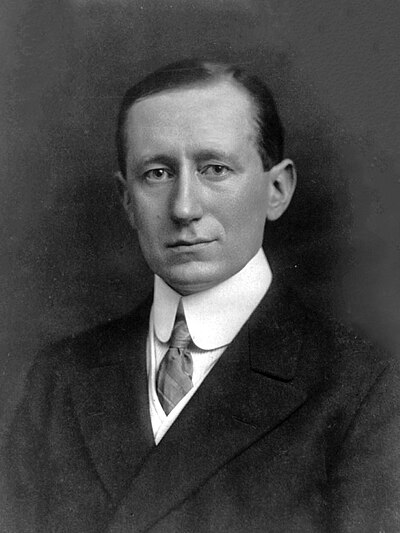
Guglielmo Marconi
Pioneer of radio communication, commercializing wireless telegraphy.
Who was Guglielmo Marconi?
Guglielmo Marconi was an Italian inventor and electrical engineer who developed a successful wireless telegraphy system. His innovations commercialized radio communication, connecting distant points without physical wires and establishing a new medium for information transfer.
“The coming of the wireless era will make it possible for people in the future to speak to each other from one end of the earth to the other.”
— Guglielmo Marconi, Attributed to Marconi, early 20th century.
Guglielmo Marconi, born in Italy in 1874, was an electrical engineer and entrepreneur who commercialized wireless telegraphy. Building on the theoretical work of others, Marconi focused on practical applications of electromagnetic waves, successfully demonstrating short-distance wireless communication in 1895. He then traveled to Britain, where he filed his first patent for a wireless telegraphy system in 1896.
Marconi's Wireless Telegraph Company, founded in 1897, quickly became instrumental in establishing commercial wireless communication. His most celebrated achievement came in December 1901, when he successfully transmitted a wireless signal across the Atlantic Ocean, from Cornwall, England, to Newfoundland, Canada. This event demonstrated the feasibility of long-distance wireless communication and significantly increased the commercial viability of radio.
The economic implications were substantial, particularly for maritime safety and long-distance communication. Ships could now communicate with shore and each other, reducing the risks of sea travel and improving coordination. The Marconi system was rapidly adopted by navies and merchant fleets worldwide, requiring investment in new equipment and training personnel. By 1912, thousands of ships were equipped with wireless apparatus.
Marconi shared the Nobel Prize in Physics in 1909 for his contributions to the development of wireless telegraphy. His work laid the foundation for commercial radio broadcasting, global telecommunications networks, and the future development of radar, creating entirely new industries and information markets. He passed away in 1937.
Key Contributions
- Developed and patented a practical wireless telegraphy system by 1896.
- Achieved the first transatlantic wireless signal transmission in December 1901, proving long-distance radio's viability.
- Founded Marconi's Wireless Telegraph Company in 1897, commercializing radio technology.
- Contributed to establishing radio as a vital tool for maritime safety and global communication, influencing billions in investment.
Legacy
Marconi's commercialization of wireless telegraphy created the radio industry, enabling instant communication across oceans and landmasses. His innovations enhanced maritime safety, established a new medium for mass communication, and laid groundwork for future electronic industries.