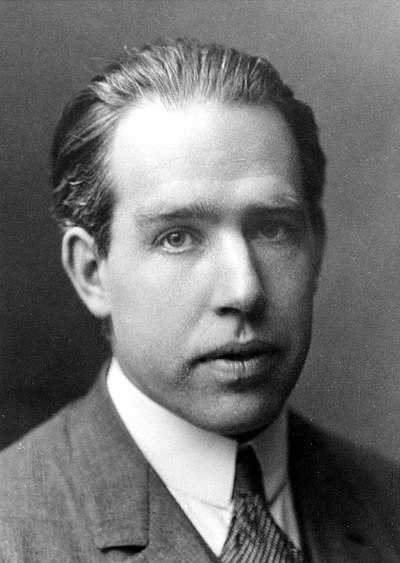
Niels Bohr
Pioneered quantum mechanics, foundational for nuclear energy and modern electronics.
Who was Niels Bohr?
Niels Bohr, a Danish physicist, developed the quantum model of the atom, establishing a core principle of quantum mechanics. His work became foundational for industries ranging from nuclear energy to semiconductors, profoundly shaping the modern technological economy.
“An expert is a person who has made all the mistakes that can be made in a very narrow field.”
— Niels Bohr, Often attributed to Bohr, various contexts
Niels Bohr, born in Copenhagen, Denmark, in 1885, made an enduring contribution to physics with his quantum model of the atom in 1913. This model, which posited that electrons orbit the nucleus in fixed energy levels, or shells, and can jump between them by absorbing or emitting specific quanta of energy, reconciled classical physics with observed atomic spectra. While later refined, Bohr's model introduced the fundamental quantum concept that underpins much of modern physics and, by extension, numerous economically vital industries.
Bohr's work on quantum mechanics provided the theoretical framework necessary for understanding the behavior of matter at the atomic and subatomic levels. This understanding was crucial for the development of nuclear physics, which by the 1940s led to the creation of nuclear weapons and subsequently nuclear power. The global nuclear power industry, with an installed capacity exceeding 390 GW in 2023, provides a significant portion of the world's electricity, representing a multi-billion dollar economic sector built upon principles derived from quantum theory.
Beyond nuclear energy, Bohr's quantum insights indirectly supported the development of solid-state physics. This field, emerging in the mid-20th century, led to the invention of the transistor in 1947, the integrated circuit in 1958, and subsequently, all modern electronics. The semiconductor industry alone generated over $500 billion in revenue in 2022, powering everything from computers and smartphones to medical devices, all reliant on the quantum mechanical behavior of electrons in materials.
Bohr also played a significant organizational and ethical role in the scientific community, particularly concerning the atomic bomb. His establishment of the Institute for Theoretical Physics in Copenhagen in 1921 became a global hub, fostering collaboration and training scientists who would drive technological progress for decades. This international collaboration model indirectly contributed to a more efficient global scientific ecosystem, accelerating discoveries with economic ramifications, such as advancements in materials science and quantum computing, which promise future economic disruption.
Key Contributions
- Proposed the quantum model of the atom in 1913, providing a foundational understanding of atomic structure.
- Contributed to the development of quantum mechanics, a theory essential for nuclear energy and solid-state electronics.
- Established the Institute for Theoretical Physics in Copenhagen in 1921, fostering international scientific collaboration.
- His work enabled the development of semiconductors, a $500 billion industry in 2022, and nuclear power, a significant global energy source.
Economic Context
Denmark's economy saw robust expansion between 1960 and 1962, with GDP increasing from $6.36 billion to $7.95 billion and GDP per capita rising to $1,711.22. This period of growth, however, was accompanied by a significant acceleration in price levels, as the inflation rate surged from a modest 1.26% to 7.38%.
Legacy
Bohr's quantum model of the atom provided fundamental insights that catalyzed the development of nuclear energy and the entire electronics industry. His work remains central to technological progress, underpinning trillions of dollars in economic activity in sectors from computing to clean energy, profoundly shaping the technological of the 21st century.