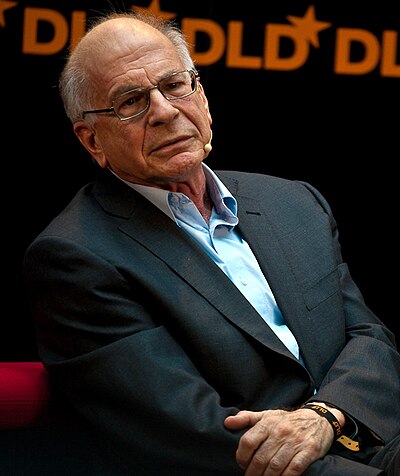
Daniel Kahneman
Integrated psychology and economics to explain irrational decision-making.
Who was Daniel Kahneman?
Daniel Kahneman, a psychologist and Nobel laureate in economics, challenged the rational actor model through his work on cognitive biases. Co-developer of Prospect Theory, he demonstrated how psychological factors systematically influence economic decisions, often leading to predictable deviations from rationality.
“We can be blind to the obvious, and we are also blind to our blindness.”
— Daniel Kahneman, *Thinking, Fast and Slow* (2011)
Daniel Kahneman, who shared the Nobel Memorial Prize in Economic Sciences in 2002 with Amos Tversky, revolutionized economics by integrating psychological insights into the study of decision-making. His foundational work, particularly Prospect Theory, developed with Tversky and published in 1979, empirically demonstrated that individuals do not always make rational choices as predicted by traditional economic theory. Instead, their decisions are influenced by cognitive biases and heuristics, especially concerning risk and uncertainty.
Prospect Theory posited that individuals evaluate potential outcomes not in terms of absolute wealth, but as gains and losses relative to a reference point, exhibiting loss aversion (losses loom larger than equivalent gains). This theory explained various economic anomalies, such as the endowment effect and risk-seeking behavior in the domain of losses. For example, investors are more likely to hold onto losing stocks than sell them, a deviation from rational market behavior. Kahneman and Tversky also identified other systematic biases, such as anchoring, availability, and representativeness heuristics.
His later work, including the best-selling book *Thinking, Fast and Slow* (2011), distilled decades of research into two distinct modes of thought: 'System 1' (fast, intuitive) and 'System 2' (slow, deliberative). This framework provided a clearer understanding of how these systems interact to produce economic choices. Kahneman's contributions laid the scientific groundwork for behavioral economics, influencing fields from finance and marketing to public policy design. His insights have led to the development of 'nudge' policies aimed at improving decision-making in areas like savings, health, and energy consumption, potentially saving billions in suboptimal choices.
Key Contributions
- Co-developed Prospect Theory (published 1979), demonstrating that individuals evaluate outcomes as gains/losses relative to a reference point, exhibiting loss aversion.
- Identified systematic cognitive biases and heuristics (e.g., anchoring, availability) that lead to predictable deviations from rational economic choice.
- Awarded the Nobel Memorial Prize in Economic Sciences in 2002 for integrating psychological research into economic science.
- Authored *Thinking, Fast and Slow* (2011), articulating System 1 and System 2 thinking, influencing understanding of consumer behavior, finance, and policy.
Economic Context
Over Daniel Kahneman's influential decades, Israel transformed from a nascent economy with a GDP of just over $3 billion in 1960 into a modern, high-income nation boasting a GDP exceeding $540 billion by 2024. This remarkable growth was reflected in a dramatic rise in living standards, with GDP per capita soaring from $1,452 to $54,176, alongside a shift from a substantial trade deficit to a $13 billion surplus by the end of the period.
Legacy
Kahneman's work fundamentally reshaped economic theory by incorporating psychological realism into models of decision-making, moving beyond the idealized rational actor. His insights inform behavioral economics, influencing policy design and market understanding, and helping to mitigate suboptimal individual and collective choices.