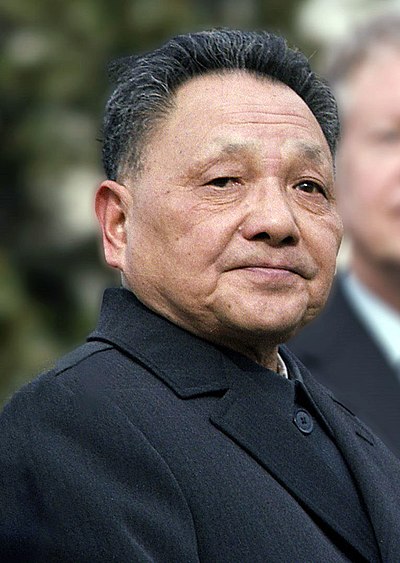
Deng Xiaoping
Architect of China's economic reforms, opening the country to market forces.
Who was Deng Xiaoping?
Deng Xiaoping, born in 1904, was a Chinese leader who orchestrated the nation's profound economic reforms from 1978 until his retirement. He initiated the policy of "socialism with Chinese characteristics," transforming China into a global economic power.
“To get rich is glorious.”
— Deng Xiaoping, Speech, 1986
Deng Xiaoping, born in 1904, emerged as China's de facto leader in 1978, succeeding Mao Zedong. He inherited an economy largely isolated and stagnant after decades of centrally planned socialism and political turmoil. Deng, who had endured political purges during the Cultural Revolution, began a radical reorientation of China's economic system, famously stating, "It doesn't matter whether a cat is black or white, as long as it catches mice."
His reforms, often referred to as "reform and opening up," dismantled collective farming and introduced the household responsibility system in agriculture, which dramatically boosted food production. By 1984, agricultural output had increased by over 8% annually. More significantly, Deng encouraged the establishment of Special Economic Zones (SEZs) starting in 1980, with Shenzhen being the most prominent. These zones offered tax incentives and more liberalized trade policies to attract foreign investment and technology.
Deng's policies also involved decentralizing economic decision-making, allowing market forces a greater role, and reforming state-owned enterprises (SOEs). This gradual transition from a command economy to a socialist market economy led to astonishing growth rates. China's GDP averaged 9.8% annual growth from 1978 to 2018, lifting hundreds of millions out of poverty and fundamentally altering the global economic balance.
He also pushed for China's integration into the global economy, setting the stage for its eventual entry into the World Trade Organization in 2001. Deng's vision of "One Country, Two Systems" for Hong Kong and Macau ensured their continued economic vibrancy after their respective handovers in 1997 and 1999. His economic legacy is one of the most successful large-scale poverty reduction and wealth creation efforts in history, albeit with significant social and environmental costs.
Key Contributions
- Launched China's economic reform and opening-up policy in 1978, transforming its planned economy.
- Established Special Economic Zones (SEZs) starting in 1980 (e.g., Shenzhen), attracting foreign investment and promoting export-oriented growth.
- Implemented the Household Responsibility System in agriculture, increasing rural incomes and boosting agricultural output by over 8% annually by 1984.
- Oversaw an era of sustained high economic growth, with China's GDP averaging 9.8% annually from 1978 to 2018.
Economic Context
China's economy underwent a remarkable transformation during Deng Xiaoping's period of influence, with its Gross Domestic Product soaring from $59.8 billion in 1960 to $967.7 billion by 1997. This explosive growth also propelled GDP per capita from $89.72 to $786.74 and shifted the nation's trade balance to a substantial $42.8 billion surplus.
Legacy
Deng Xiaoping's economic reforms transformed China from an impoverished, isolated nation into a global economic superpower. His pragmatic blend of market mechanisms and state control created an period of growth, profoundly altering global trade and geopolitics.