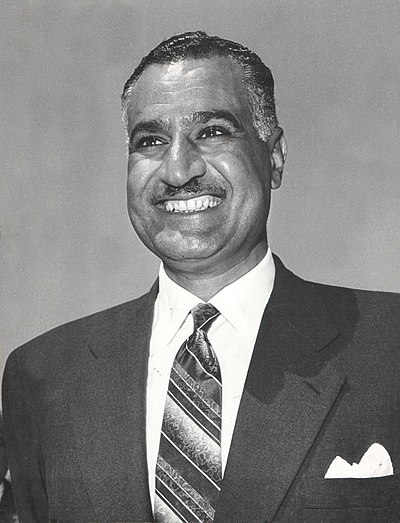
Gamal Abdel Nasser
Introduced Arab socialism and state control to Egypt's economy, modernizing its infrastructure.
Who was Gamal Abdel Nasser?
Gamal Abdel Nasser served as President of Egypt from 1956 to 1970, implementing a socialist economic agenda. His policies included extensive land reform, nationalization of key industries, and the construction of the Aswan High Dam, aiming for economic independence and industrialization.
“We shall build a strong Egypt, not dependent on the outside, but self-sufficient and capable of asserting its will.”
— Gamal Abdel Nasser, Speech on the nationalization of the Suez Canal, 1956.
Gamal Abdel Nasser came to power following the 1952 revolution and served as President of Egypt from 1956 until his death in 1970. He pursued a policy of "Arab Socialism," centered on state control of the economy and a redistribution of wealth. The Agrarian Reform Law of 1952 limited land ownership to 200 feddans (approximately 208 acres) per individual, with excess land distributed to landless peasants, aiming to break the power of large landowners and improve rural equity.
His government engaged in widespread nationalization, starting with the Suez Canal Company in 1956, a move that precipitated the Suez Crisis. This was followed by the nationalization of banks, insurance companies, and major industrial and commercial firms throughout the late 1950s and early 1960s, bringing a significant portion of the economy under public ownership. By 1967, state-owned enterprises accounted for over 85% of industrial production and 90% of foreign trade.
Nasser also oversaw massive infrastructure projects, most notably the construction of the Aswan High Dam, completed in 1970 with Soviet financial and technical assistance. The dam significantly expanded agricultural land by 1.2 million feddans, provided hydroelectric power, and controlled Nile River flooding, supporting industrialization efforts. However, his state-led model also suffered from bureaucratic inefficiencies, a drain on state resources, and a growing external debt, which reached approximately $4 billion by 1970.
Key Contributions
- Implemented the Agrarian Reform Law of 1952, limiting land ownership and redistributing land to peasants.
- Nationalized key industries, including the Suez Canal Company in 1956, and placed over 85% of industrial production under state control by 1967.
- Oversaw the construction of the Aswan High Dam, completed in 1970, increasing agricultural land by 1.2 million feddans.
- Increased Egypt's external debt to approximately $4 billion by 1970 due to extensive state spending and economic inefficiencies.
Economic Context
Egypt's economy under Gamal Abdel Nasser experienced significant expansion between 1960 and 1970, with its GDP nearly doubling from $4.2 billion to over $8 billion, though GDP per capita grew more modestly to $232.27 amidst a rapidly increasing population. This growth was accompanied by rising inflationary pressures, with the rate climbing to 3.76%, and a widening trade deficit that reached $283 million by the end of the decade.
Legacy
Nasser's economic policies established a state-dominated economy in Egypt, fundamentally reshaping its industrial and agricultural sectors. While achieving infrastructure modernization and social redistribution, his centralized model also led to inefficiencies and significant state debt, influencing Egypt's economic trajectory for decades.