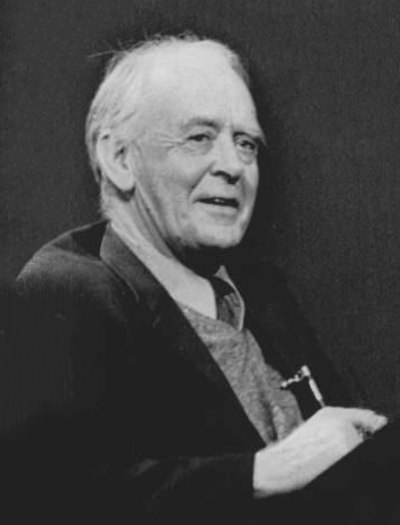
John Hicks
Synthesized economic theory, famous for the IS-LM model and general equilibrium.
Who was John Hicks?
British economist John Hicks (1904–1989) significantly advanced general equilibrium theory and macroeconomics. He is best known for developing the IS-LM model in 1937, which graphically integrated classical and Keynesian economic concepts.
“If economists are apt to be preachy, it is because they have so much good advice to give.”
— John Hicks, *Causality in Economics*, 1979
John R. Hicks (1904–1989) was a British economist awarded the Nobel Memorial Prize in Economic Sciences in 1972. His work spanned microeconomics, macroeconomics, and economic history, marked by a drive for theoretical coherence and logical rigour. Hicks's early contributions included a reformulation of consumer theory, introducing indifference curves and diminishing marginal rate of substitution, concepts clarified in his 1939 work, *Value and Capital*.
A major contribution to macroeconomics was his development of the IS-LM model in his 1937 paper "Mr. Keynes and the 'Classics': A Suggested Interpretation." This model provided a two-equation system (Investment-Saving and Liquidity Preference-Money Supply) to represent the interactions between the goods market and the money market. The IS-LM framework quickly became a standard tool for teaching macroeconomics, influencing policy discussions for decades by illustrating how fiscal and monetary policies might affect output and interest rates.
Hicks also made significant contributions to general equilibrium theory, building on the work of Walras. His *Value and Capital* provided a more rigorous mathematical framework for understanding how prices and quantities in different markets interact to achieve equilibrium. Later in his career, he explored dynamic economic systems and contributed to welfare economics, including his analysis of the compensation principle. He published over 25 books and numerous articles throughout his career, including *A Theory of Economic History* in 1969.
Key Contributions
- Introduced the IS-LM (Investment-Saving / Liquidity Preference-Money Supply) model in 1937, a core macroeconomic framework.
- Authored *Value and Capital* (1939), which refined general equilibrium theory and consumer choice analysis using indifference curves.
- Awarded the Nobel Memorial Prize in Economic Sciences in 1972 for his contributions to general equilibrium theory and welfare economics.
Economic Context
During John Hicks's period of influence, the United Kingdom's economy experienced substantial nominal growth, with GDP per capita surging from £1,397 in 1960 to £16,239 by 1989. However, this expansion was accompanied by persistent inflationary pressures, rising from 1% in 1960 to 5.76% in 1989, alongside a notable deterioration in the trade balance, which swung from a £1.4 billion surplus in 1970 to a £31.5 billion deficit by 1989.
Legacy
Hicks provided foundational tools for macroeconomic analysis and clarified microeconomic theory through rigorous mathematical formulations. His IS-LM model endured as a pedagogical and analytical instrument in economics departments worldwide for over 50 years, shaping generations of economists' understanding of aggregate demand.