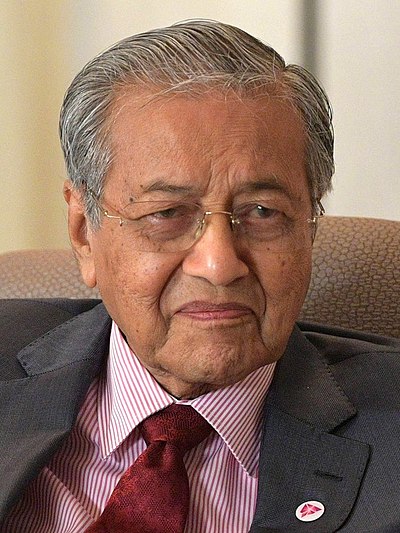
Mahathir Mohamad
Modernized Malaysia through industrial policy, infrastructure, and 'Look East' strategies.
Who was Mahathir Mohamad?
Serving as Malaysia's Prime Minister for over two decades, Mahathir Mohamad transformed the nation into a rapidly industrializing economy. He championed state-led heavy industries, extensive infrastructure projects, and an assertive stance in global economics.
“We want to be masters in our own house.”
— Mahathir Mohamad, Speech at the Malaysian Institute of Economic Research, 1997
First becoming Prime Minister in 1981, Mahathir Mohamad aimed to shift Malaysia from a commodity-dependent economy to an industrialized one. His 'Look East' policy, introduced in 1982, encouraged the adoption of Japanese and Korean work ethics and management practices, fostering export-oriented growth. Malaysia’s economy grew at an average annual rate of over 7% during most of his first tenure (1981-2003).
Under his leadership, Malaysia ed on ambitious heavy industrialization projects, notably including the establishment of Proton, a national car manufacturer, in 1983. Significant infrastructure developments, designed to boost connectivity and trade, encompassed the construction of the Petronas Towers, completed in 1998, and the Kuala Lumpur International Airport, which opened in 1998.
During the 1997 Asian Financial Crisis, Mahathir controversially defied IMF advice, imposing capital controls and fixing the ringgit to the U.S. dollar at 3.8:1 in 1998. This shielded Malaysia from further capital outflows, allowing it to recover quickly compared to some regional peers. His administration also pursued privatization, selling off state-owned entities to enhance efficiency and reduce the public sector's burden.
Key Contributions
- Introduced the 'Look East' policy in 1982, promoting Japanese and Korean industrial models.
- Established the national car manufacturer Proton in 1983, fostering domestic heavy industry.
- Oversaw an average annual economic growth exceeding 7% for much of his 1981-2003 tenure.
- Implemented capital controls and fixed the ringgit to the U.S. dollar at 3.8:1 in 1998 during the Asian Financial Crisis.
Economic Context
Malaysia's economic fortunes transformed dramatically during Mahathir Mohamad's extensive period of influence, evolving from an economy with a GDP per capita of just $240.85 in 1960 to a considerably more prosperous one reaching $11,874.43 by 2024. This ascent was fuelled by robust growth and a substantial expansion in its trade surplus, which ballooned from $264 million to more than $22 billion, indicating a successful export-oriented strategy.
Legacy
Mahathir's policies transformed Malaysia into a modern industrial economy through strategic state intervention and large-scale infrastructure projects. His distinctive approach to economic crises and assertive nationalist development agenda left Malaysia with robust industrial capabilities and a complex legacy regarding state-market relations.