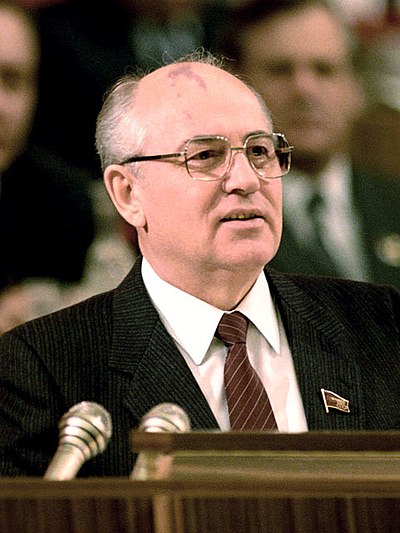
Mikhail Gorbachev
Attempted to reform the Soviet economy through Perestroika, leading to its collapse.
Who was Mikhail Gorbachev?
As the last leader of the Soviet Union, Mikhail Gorbachev introduced 'Perestroika' and 'Glasnost' to revitalize a stagnant economy and society. His reforms, while intended to modernize the system, ultimately accelerated the dissolution of the Soviet state.
“We want to make the economy more dynamic and more responsive to social needs.”
— Mikhail Gorbachev, Speech to the Central Committee, 1985
Mikhail Gorbachev assumed leadership of the Soviet Union in 1985, inheriting an economy burdened by stagnation, inefficiency, and chronic shortages. He initiated 'Perestroika' (restructuring) to introduce market-like mechanisms into the centrally planned system. Early policies included attempts to increase industrial efficiency and combat alcoholism, with the 1985 anti-alcohol campaign resulting in a 25% drop in officially recorded alcohol sales by 1987.
The Law on State Enterprise, enacted in 1987, aimed to grant more autonomy to state enterprises and link worker pay to productivity, decentralizing some economic decision-making. However, these reforms often led to supply chain disruptions and the rise of informal markets, failing to address fundamental structural issues. By 1989, the Soviet Union faced growing budget deficits, which exceeded 10% of GDP.
Further attempts to liberalize prices and permit private cooperatives created widespread inflation and aggravated consumer goods shortages, eroding public trust in the state. Real GDP growth rates, already slowing, turned negative in the final years of his leadership, contracting by approximately 2.3% in 1990 and 11% in 1991, directly preceding the Soviet Union's dissolution in December 1991.
Key Contributions
- Introduced "Perestroika" in 1985, attempting to inject market elements into the Soviet command economy.
- Enacted the Law on State Enterprise in 1987, granting limited autonomy to state-run firms.
- Permitted the establishment of private cooperatives in 1988, signaling a departure from strict state ownership.
- Presided over a period where the Soviet GDP contracted by 2.3% in 1990 and 11% in 1991.
Economic Context
During Mikhail Gorbachev's reform period, the economy of the nascent Russian Federation faced growing instability and rampant inflation, reaching 135.65% by 1991. Although GDP per capita stood at $3,778.02 in 1988, these tumultuous years ultimately reshaped its economic trajectory, paving the way for a post-Soviet era where GDP per capita climbed to $15,619.61 by 2022.
Legacy
Gorbachev's economic reforms inadvertently exposed the deep structural flaws of the Soviet command economy, leading to hyperinflation and severe shortages. His efforts ultimately dismantled the centralized economic system, paving the way for market economies in Russia and former Soviet states, albeit through a tumultuous transition.