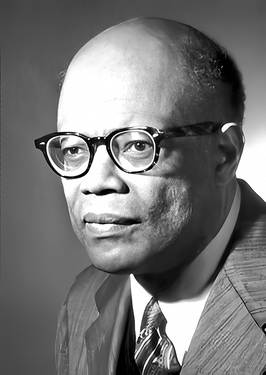
W. Arthur Lewis
Developed the dual-sector model of economic development for labor-surplus economies.
Who was W. Arthur Lewis?
A Saint Lucian economist, awarded the Nobel Memorial Prize in Economic Sciences in 1979, known for his dual-sector model of economic development. His 1954 theory explained how developing economies could grow through transferring surplus labor from subsistence agriculture to modern industrial sectors, a process that influenced post-colonial economic planning.
“The main object of economic development is to raise the general standard of living, to abolish poverty and to make possible an age of leisure for all.”
— W. Arthur Lewis, "The Principles of Economic Planning," 1949
W. Arthur Lewis (1915–1991) was a Saint Lucian economist who made significant contributions to development economics. Educated at the London School of Economics, he became a professor at the University of Manchester in 1948 and later served as Vice-Chancellor of the University of the West Indies from 1959 to 1963. Lewis was among the first Black scholars to be appointed a full professor at a British university.
His most influential work, "Economic Development with Unlimited Supplies of Labour" (1954), proposed a dual-sector model for developing economies. This model posits that developing nations often have a large, low-productivity subsistence agricultural sector with surplus labor, from which workers can be transferred to a high-productivity industrial sector. This transfer allows for industrial expansion without increasing real wages in the modern sector until the agricultural surplus labor is fully absorbed. This framework explained how rapid industrialization could occur, driven by profits reinvested by capitalists in the modern sector.
Lewis's model was highly influential in the 1950s and 1960s, providing a theoretical justification for industrialization strategies adopted by many newly independent nations, particularly in Asia and Africa. He was an economic advisor to various governments, including Ghana (1957) and Nigeria, and worked with several international organizations. His analysis emphasized the importance of capital accumulation and entrepreneurship in driving economic transformation, moving beyond a sole focus on natural resources.
For his pioneering research into economic development with particular regard to the problems of developing countries, he shared the Nobel Memorial Prize in Economic Sciences in 1979 with Theodore Schultz. Lewis's insights into the dynamics of labor migration and the structural transformation of economies remain relevant in contemporary discussions about global development.
Key Contributions
- Published "Economic Development with Unlimited Supplies of Labour" (1954), introducing the dual-sector model of economic growth.
- Explained how economies with surplus labor could industrialize by transferring workers from low-productivity agriculture to high-productivity industry.
- Served as an economic advisor to developing nations, including Ghana (1957) during its post-independence planning.
- Awarded the Nobel Memorial Prize in Economic Sciences in 1979 for his contributions to development economics.
Economic Context
Between 1960 and 1991, the United Kingdom saw robust economic expansion, with GDP per capita climbing from $1,397.59 to $19,900.73. However, this progress was shadowed by escalating price pressures, as inflation rose to 7.46% by 1991, and a weakening external trade position, moving from surplus to a $1.4 billion deficit.
Legacy
Lewis's dual-sector model provided a foundational framework for understanding economic development in labor-surplus economies, influencing post-colonial development strategies for decades. His emphasis on structural transformation and capital accumulation continues to inform theories of economic growth and industrialization.