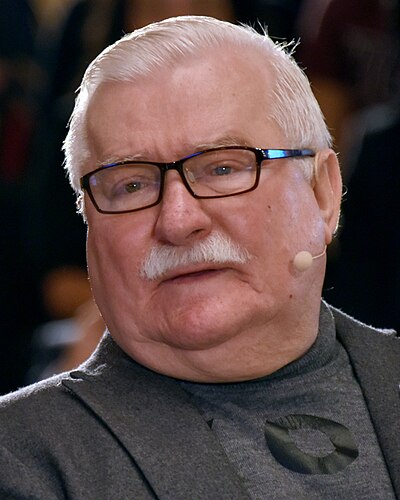
Lech Walesa
Led Solidarity, initiating Poland's transition from communism to a market economy.
Who was Lech Walesa?
Lech Walesa, a shipyard electrician, co-founded and led Solidarity, the first independent trade union in the Soviet bloc, from 1980. His activism directly challenged the communist regime, culminating in negotiations that ushered in Poland's transition to a market economy and democracy.
“We, the people of Poland, an ancient nation, deeply rooted in history, want to build our life upon the principles of freedom, democracy, and economic prosperity.”
— Lech Walesa, Address to the U.S. Congress, 1989.
Lech Walesa, a Gdańsk shipyard electrician, rose to prominence in August 1980 as a leader of the strikes that established Solidarity (Solidarność), the Soviet bloc's first independent trade union. This movement directly challenged state control over labor and economic life in communist Poland. Solidarity quickly amassed 10 million members, representing approximately one-third of the country's working-age population, signaling deep economic dissatisfaction and a desire for greater autonomy.
Walesa's leadership of Solidarity was instrumental in the Round Table Talks of 1989, which led to semi-free elections and the peaceful transfer of power in Poland. As President from 1990 to 1995, he oversaw the initial, difficult phases of "shock therapy" economic reforms, championed by Finance Minister Leszek Balcerowicz. These reforms included rapid privatization, price liberalization, and fiscal stabilization, designed to convert a command economy into a market one swiftly.
The economic transition under Walesa's presidency resulted in short-term hardships, including high unemployment—reaching 16.4% in 1993—and rising income inequality. However, these policies also laid the groundwork for Poland's sustained economic growth and its eventual integration into the European Union in 2004. By the end of his term, Poland had begun to show signs of recovery, with GDP growth reaching 7% in 1995, transforming it into one of the most successful transition economies.
Key Contributions
- Co-founded and led Solidarity from 1980, challenging state economic control and mobilizing 10 million members.
- Key participant in the 1989 Round Table Talks, facilitating Poland's peaceful transition from communism.
- As President (1990-1995), oversaw the implementation of "shock therapy" economic reforms, including privatization and liberalization.
- Presided over the initial period that led to Poland's integration into the European Union in 2004 and sustained GDP growth, reaching 7% in 1995.
Economic Context
During Lech Walesa's period of influence, Poland's economy underwent a fundamental restructuring, transitioning from a centrally planned system to a market economy. This transformation propelled GDP per capita from $1,600.05 in 1980 to an estimated $25,103.57 by 2024, demonstrating a marked increase in prosperity. Concurrently, the nation's trade balance registered a surplus of $36.7 billion in 2024.
Legacy
Walesa's leadership broke the communist economic monopoly in Poland, enabling a rapid shift towards market principles. His influence on the post-communist economic transition established the foundations for Poland's later economic integration with Western Europe and its sustained growth.